
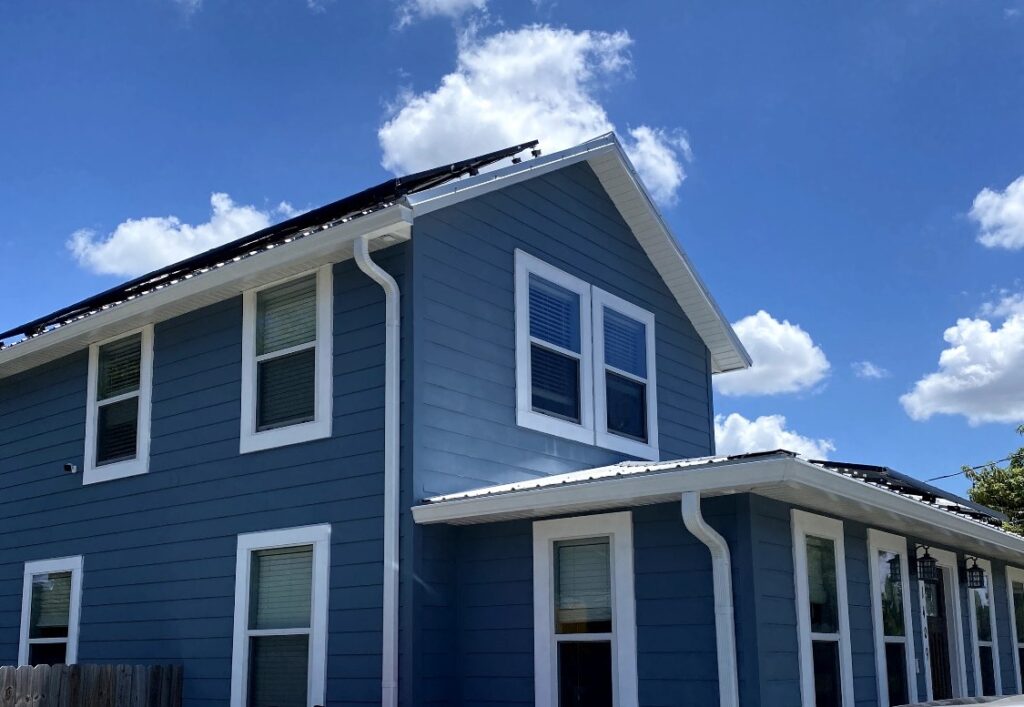
On a Pennsylvania home, the relationship between the roof drip edge and the gutter matters just as much as the size of the gutter itself. The simplest rule is that water leaving the roof should fall into the gutter—not travel behind it onto the fascia.
That does not mean the entire gutter is pushed tightly underneath the roof. It means the upper rear edge of the gutter should be positioned beneath or behind the lower edge of the drip edge, or an appropriate gutter apron should bridge the transition. The exact detail depends on the roof edge, fascia, shingles, flashing profile, and hanger location.
What the drip edge is designed to do
Drip edge is metal flashing installed along the roof perimeter. At the eave, its job is to help water leave the shingles cleanly, protect the roof edge and fascia, and direct runoff toward the gutter. Roofing manufacturer IKO describes drip edge flashing as a component that directs water away from the fascia and into the gutter.
The gutter then collects that runoff and moves it through the outlets, downspouts, and ground-level discharge path. These are separate components, but they must overlap correctly to form one continuous drainage route.
Why the gutter should receive water below the drip edge
If the gutter sits too low, too far away from the fascia, or completely in front of a short drip edge, runoff can follow the metal by surface tension and move behind the gutter. The same problem can occur when the drip edge is pressed tightly against the fascia and does not project far enough to release water into the channel.
Correct positioning helps:
- direct roof runoff into the gutter instead of behind it;
- reduce repeated wetting of fascia and soffit components;
- keep water from reaching hanger penetrations and the rear gutter seam;
- limit staining on siding and trim below the roof edge;
- give the gutter a reliable starting point before water moves toward the downspout.
Placement alone cannot fix a clogged outlet, incorrect pitch, undersized drainage layout, damaged fascia, or a roof flashing defect. The entire path still needs to be evaluated.
What can happen when the gutter and drip edge do not overlap correctly
Water runs behind the gutter
During rain, homeowners may see a narrow stream between the back of the gutter and the fascia. Sometimes the gutter itself is clear and flowing, but part of the roof runoff never enters it.
Fascia stays wet
Repeated wetting can contribute to peeling paint, staining, soft wood, loose fasteners, or deterioration of fascia covering. A gutter hanger cannot remain secure if the material supporting it has been weakened.
Soffit staining appears below the eave
Water reaching the roof edge can travel along trim, seams, and fasteners before it becomes visible. A stain below the gutter does not automatically identify the exact entry point, so the drip edge, roof edge, gutter position, and fascia condition should be inspected together.
Winter conditions make the defect more visible
Pennsylvania freeze-thaw cycles can expose small drainage problems. Water that reaches the space behind a gutter may freeze, expand, and leave staining or separation after it thaws. Gutters and drip edge do not prevent roof ice dams caused by heat loss or roofing conditions, but the roof-edge drainage detail should still direct liquid water correctly whenever melting occurs.
Signs Pennsylvania homeowners can check from the ground
Observe the roof edge during ordinary rain from a safe location. Do not climb a wet or icy ladder. Look for:
- water dripping between the gutter and fascia;
- dark lines or peeling finish directly behind the gutter;
- overflow even though the gutter channel appears clear;
- a visible gap where the gutter has pulled away from the roof edge;
- one section sitting noticeably lower than the surrounding run;
- soft, split, or discolored fascia near hanger locations;
- icicles forming behind the gutter rather than only at its front edge;
- water reaching the wall or soffit below the eave.
A short video taken from the ground during rain can show whether water crosses the front edge, runs behind the gutter, or never reaches the channel.
When a gutter apron or flashing correction may be needed
Some roof edges have a drip edge that is too short to reach the gutter after the gutter is set at the proper pitch. In other cases, the existing flashing is bent, damaged, pressed flat against the fascia, or interrupted by previous repairs. A compatible gutter apron or other properly designed flashing detail may be needed to bridge the gap.
This should not be improvised by forcing the gutter against damaged roofing materials or randomly bending the roof edge. Altering drip edge, underlayment, shingles, or roof flashing may belong to a roofer. The estimate should state whether the work covers gutter positioning only, fascia repair, or coordination with a roofing contractor.
Why gutter height cannot be identical along the full run
A gutter needs controlled pitch toward an outlet. That means its position relative to the drip edge can change slightly from one end of a long run to the other. The installer must balance proper slope with enough overlap to keep roof runoff entering the gutter.
Adding more pitch is not always better. An excessive drop can create a visible gap below the drip edge at the low end, reduce useful capacity at the high end, or produce an uneven appearance. The roofline, outlet locations, run length, and number of downspouts should be planned together.
Coordinate gutters and drip edge during roof replacement
The best time to resolve an uncertain roof-edge detail is often when the roof is being replaced. The roofer can confirm the drip edge, underlayment, shingles, and fascia condition before the gutter is reinstalled. The gutter installer can then set the final height, pitch, hanger spacing, outlets, and downspouts.
Our guide to planning gutters during a Pennsylvania roof replacement explains how the two trades can coordinate their work without leaving an unfinished drainage gap.
What a proper gutter inspection should include
- Trace water from the shingles across the drip edge and into the gutter.
- Check the rear gutter edge, hangers, fascia, and visible roof-edge flashing.
- Confirm that the gutter maintains usable overlap while pitching toward an outlet.
- Inspect outlets, 3×4 downspouts, elbows, and ground-level discharge.
- Identify whether the solution is repositioning, gutter repair, fascia work, flashing coordination, or complete 6-inch seamless gutter installation.
If the fascia is already stained, soft, or unable to hold fasteners, review the related Pennsylvania soffit and fascia service before simply reattaching the gutter.
Request a Pennsylvania gutter assessment
Gutters Marketplace LLC serves Reading, Sinking Spring, Wyomissing, West Lawn, Spring Township, Shillington, and surrounding Berks County communities. We inspect how the roof edge, gutter, downspouts, and discharge path work together before recommending a repair or replacement.
Request a free Pennsylvania estimate or call 484-339-4177. Homeowners do not need to be present when exterior access is available.