
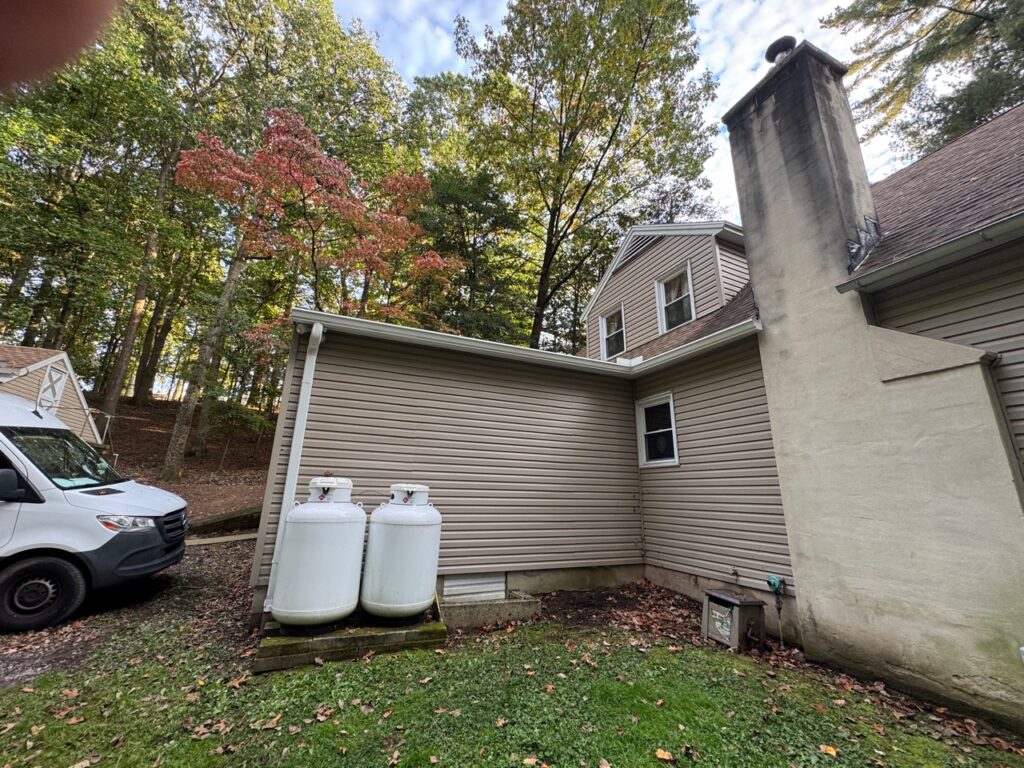
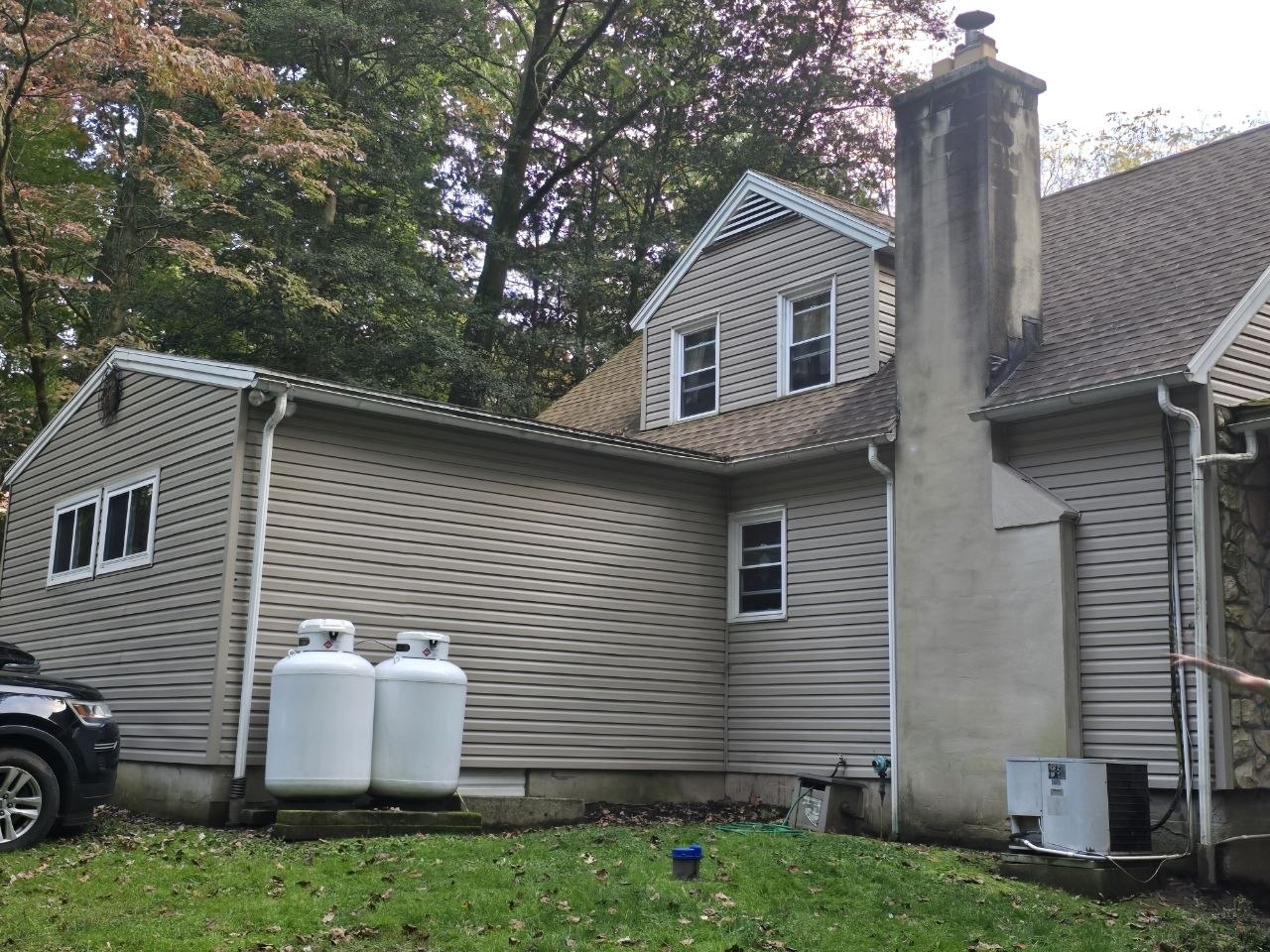
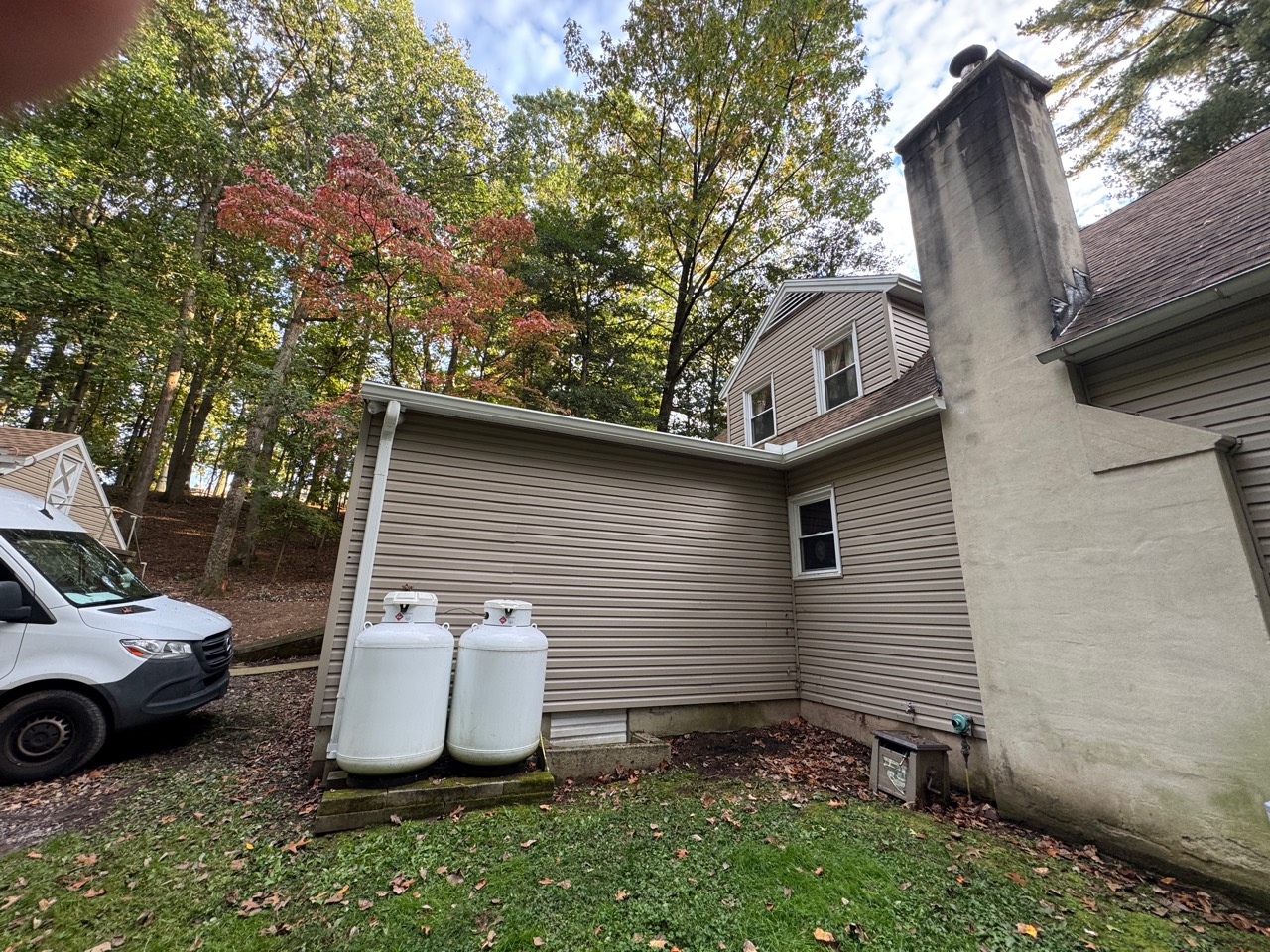
Before and after our gutter and wood fascia installation project in Sinking Spring, Pennsylvania.
Before and after
K-style versus half-round gutters
Why choose K-style gutters? Their flat back fits closely against a straight fascia board, creating a neat roofline and allowing secure mounting. Unlike the curved profile of half-round gutters, K-style offers a trim-like appearance that complements many homes.
How proper roof-edge flashing helps protect wood fascia
The connection to the roof edge matters just as much as the gutter shape. Properly installed, the gutter’s rear edge sits behind overlapping drip-edge flashing or a gutter apron, directing runoff into the gutter instead of behind it. This helps protect wooden fascia from repeated wetting and reduces the risk of rot.
Correct slope, secure fastening, clear outlets and properly routed downspouts complete the system. Half-round gutters can also perform well—good installation is essential with either style.
Does every gutter project need new drip edge?
No. The correct answer depends on the existing roof-edge assembly and its condition. If serviceable drip edge or gutter apron already directs roof runoff into the gutter, replacing it may not be part of the gutter scope. If flashing is missing, damaged, too short, or sends water behind the gutter, the roof edge needs a closer review before installation.
Existing drip edge should not be lifted, cut, or damaged just to make a gutter fit. When the roof design and manufacturer instructions allow it, the upper rear edge of the gutter is typically positioned behind or beneath the lower edge of the flashing so water enters the gutter rather than the fascia cavity.
What creates a secure gutter attachment?
A gutter is only as secure as the material holding its fasteners. Hangers should be placed according to the gutter system, roof geometry, expected loads, and manufacturer guidance, with screws anchored into sound structural material—not loose, split, or rotted fascia. Where exposed rafter tails or a nonstandard roof edge are present, the attachment method should be selected for that construction instead of forcing a standard fascia-mounted detail.
- Confirm that the fascia and roof-edge wood are sound before fastening.
- Set the gutter so roof runoff enters the trough without flowing behind it.
- Maintain a controlled pitch toward properly sized outlets.
- Use enough secure hangers for the system and site conditions.
- Route downspouts and extensions to a suitable discharge point.
If several runs have loose hangers, failed seams, poor pitch, or damaged fascia, compare gutter repair versus replacement. For outlet or discharge problems, review our Pennsylvania downspout repair service.
Assess the wood before choosing a fascia repair
The project photographs show the visible roofline before and after installation. They do not show every concealed fastening point, the back of the fascia, or a moisture survey. Use them to discuss the finished appearance; ask for a separate condition assessment when deciding what wood can remain on your own home. The inspection examples below are hypothetical and are not additional findings from this Sinking Spring project.
Separate a coating problem from deterioration of the board
Peeling paint, dark marks and a loose gutter deserve investigation, but they do not identify the same repair. The USDA Forest Products Laboratory’s wood-deterioration guidance distinguishes molds, stains and decay and explains that fungi depend on moisture and suitable environmental conditions. A photograph of discoloration alone cannot establish how much usable wood remains or whether a proposed fastening location is sound.
Ask the contractor to identify the affected board, its accessible faces, the condition around existing fasteners and any areas hidden by trim or the gutter. An assessment should distinguish a surface that needs preparation and finishing from wood that cannot support the proposed attachment. If the back of the board or the supporting structure cannot be examined without removal, the proposal should state that limitation instead of presenting concealed material as already inspected.
Use moisture readings as evidence, not a stand-alone pass or fail
Oregon State University Extension explains that wood exchanges moisture with its surroundings and can shrink or swell as conditions change. It also describes differences between moisture-meter types and measurement methods. A useful inspection record therefore identifies the measurement location, instrument and conditions, rather than reporting an unexplained number for the entire roof edge.
A reading taken after rain answers a different question from one taken during a dry interval. Ask whether the accessible face and suspected problem area were both checked, and what remains untested. A low reading does not demonstrate fastener holding strength or reverse earlier deterioration. Likewise, one elevated reading does not define how many feet of fascia must be replaced. The contractor should explain how moisture evidence, visible condition and the attachment assessment lead to the proposed scope.
Resolve the wetting route as well as the visible damage
PNNL’s roof-and-wall flashing guidance connects missing or poorly functioning water-control details with damage that may extend behind finished surfaces. At a gutter job, ask whether the observed wetting comes from the roof-edge connection, an overflowing trough, a leaking joint or another nearby detail. Repainting or replacing the visible board is a different task from correcting that water path.
Keep the responsibilities explicit. If a roofer must repair the roof-edge assembly before the gutter can be mounted, identify that work and its sequence. If inspection reveals deterioration behind the fascia, stop treating the job as a simple face-board replacement until the supporting material has been assessed. A new finish or metal cover should not be used as evidence that the hidden substrate is suitable for attachment.
Compare two possible inspection outcomes
Hypothetical limited repair: the contractor finds a localized coating failure, documents sound accessible wood at the proposed attachments and identifies a leaking gutter joint nearby. The written scope separates the joint repair from surface preparation and finishing, states which wood remains, and records any concealed areas that were not opened. This is more informative than a line item simply labeled “repair fascia.”
Hypothetical expanded repair: removal exposes deteriorated fascia and a questionable supporting area. The contractor documents the exposed condition, explains the additional assessment or carpentry needed, and provides a revised scope before covering the area again. That scope should identify the affected locations, replacement material, finishing responsibility and who restores the gutter and flashing connection. Neither example establishes a universal replacement length, price or fastening schedule.
For comparable estimates, ask each bidder to state what is included in the initial inspection, what removal is included, how concealed damage will be documented and how additional work will be approved. Keep photographs of exposed conditions with the final scope and completion record. That record helps distinguish work completed now from inaccessible areas or related roof repairs that remain outside the agreement.
Check compatibility between the fascia, gutter and fasteners
Sound wood and secure attachment are only part of the specification. If a repair introduces preservative-treated fascia, ask which treatment is proposed and how it will contact the gutter, flashing, hangers and screws. A description such as “treated board with exterior screws” does not identify those materials well enough to check their compatibility. This is a question for the proposed assembly, not a reason to assume that the photographed project used treated wood.
Identify the treatment rather than relying on the board’s color
Viance’s treated-wood guidance explains that the lumber end tag identifies the preservative and intended use. Its installation recommendations distinguish between Ecolife, which it permits in contact with aluminum, and Preserve CA, for which it does not recommend direct aluminum contact. These product-specific differences are why neither “all treated wood is suitable” nor “all treated wood must be avoided” is a useful specification. Ask the installer to check the actual lumber and aluminum-product instructions before ordering the replacement.
Review the connection as a complete set of materials
Simpson Strong-Tie’s material-selection guidance considers exposure conditions and treatment chemicals when selecting fastener and connector materials or coatings. Its general corrosion guidance also calls for compatibility with the connected hardware. Selecting a screw for contact with wood does not, by itself, approve its use with every hanger or gutter metal. Ask for the specific fastener and hanger products, their permitted applications, and any manufacturer-required separation detail. A generic promise to add tape or paint is not a substitute for an approved assembly.
For a hypothetical partial fascia replacement, the existing gutter may be reusable while the proposed new board introduces a different treatment at one section. The contractor should resolve that interface before reinstalling the gutter, rather than assuming the old fastener choice remains suitable. The quote can name the board, hanger and fastener products and identify any required isolation work separately. Product labels or data sheets kept with the project record make later repairs easier to match. This compatibility review complements the earlier wood-condition assessment; it does not determine hanger spacing, screw length or structural capacity for an individual home.
Gutter installation in Sinking Spring, PA
Planning a gutter or fascia project in Sinking Spring or nearby Pennsylvania communities? Explore our gutter services in Sinking Spring and contact Gutters Marketplace for an estimate.
Learn about our Pennsylvania gutter installation services.