
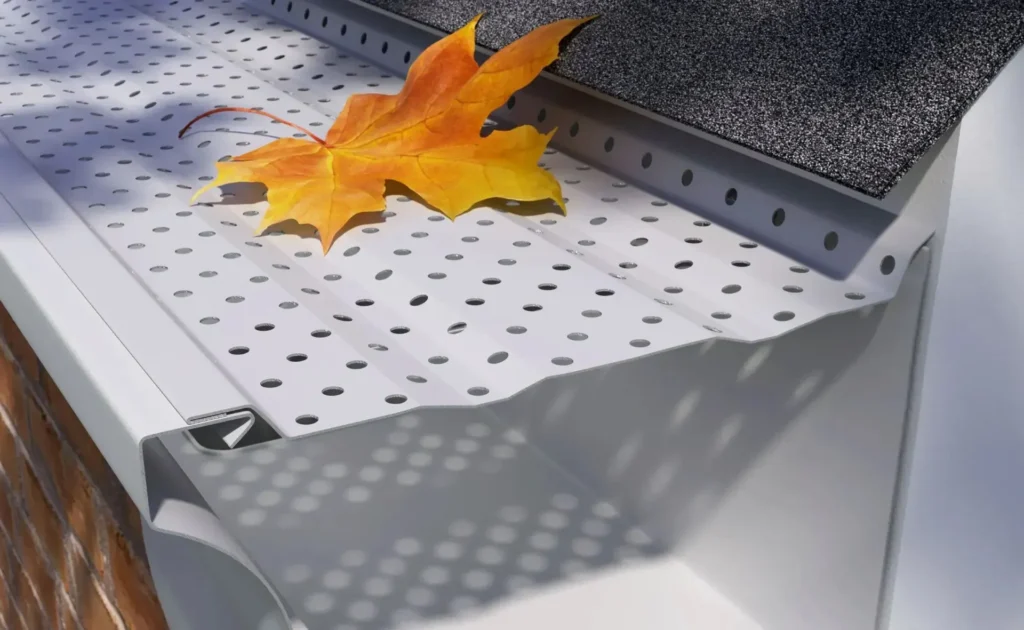
Gutter guards can make a Pennsylvania gutter system easier to manage, but they do not turn it into a maintenance-free system. The useful question is not simply whether guards “work.” It is whether the guard style matches the debris, roof layout, gutter condition, and water flow at a particular home.
When evaluating gutter guards in Pennsylvania, start with the whole drainage path: the roof sheds water and debris, the guard filters what reaches the gutter, the gutter carries the water, and the downspouts discharge it. A guard can help at one part of that path. It cannot correct a problem somewhere else.
What gutter guards can do well
A properly fitted cover can keep many leaves, twigs, and larger pieces of debris from settling inside the gutter channel. That can reduce the amount of material that has to be scooped out and can help keep the area around a downspout outlet from becoming packed with large debris.
Guards can be especially useful when leaves repeatedly collect along accessible roof edges. They also make the condition of surface debris easier to see from the ground. A line of leaves resting on top of the cover is different from a hidden gutter packed to the top.
The result should be described accurately: guards can reduce debris entry and cleaning work. They do not eliminate inspection, and their performance still depends on installation details and the existing gutter system.
What gutter guards cannot fix
A guard will not correct a gutter that is loose, badly pitched, undersized for the roof area, or leaking at a joint. It also will not repair deteriorated fascia behind the gutter. Those conditions should be addressed before or as part of any guard project. Installing a cover over a weak or poorly draining system can hide the original problem without solving it.
Guards also cannot control every place where water speeds up. Roof valleys can send a concentrated stream toward a short section of gutter. During a hard rain, that location may need closer attention even when the rest of the run performs normally. If water passes over the outside edge, the cause may be the valley flow, a blocked surface, gutter alignment, or a drainage limitation—not automatically a failed guard.
Fine material can still matter. Roof grit, pollen, seed fragments, and small organic particles may settle on the cover or work through openings over time. A wet layer on top of the guard can slow water entry. This is why “never clean again” is not a realistic way to judge a gutter-protection system.
Five checks before choosing a guard
1. Confirm that the existing gutters drain correctly
Watch the system during ordinary rain from a safe position on the ground. Look for standing water, overflow, drips at joints, water running behind the gutter, or a downspout that does not discharge. If those symptoms are present, begin with a gutter repair evaluation rather than covering the symptom.
2. Identify the debris that actually reaches the roof
Large leaves, small seeds, twigs, and fine roof material behave differently. A wide opening may pass water quickly but admit smaller debris. A finer surface may block more material but can need surface clearing when debris mats over it. The right comparison is based on the property, not only on a product label.
3. Pay attention to valleys and inside corners
These are common concentration points. Check whether water and debris arrive at one short section faster than the gutter can accept them. The guard layout and any flow-control detail should be planned around the roof shape rather than installed as one identical treatment everywhere.
4. Inspect the fascia, hangers, and gutter edge
The guard needs a stable base. Loose fasteners, separated gutter sections, damaged fascia, and uneven edges should not be ignored. The cover should fit without forcing the gutter out of position or creating gaps where debris can enter.
5. Keep future inspection possible
Ask how the gutter and downspout outlet can be checked later. A system that cannot be inspected or serviced without unnecessary disassembly may make a simple maintenance visit more complicated. Good planning includes access after installation, not just appearance on day one.
What maintenance still looks like after installation
Maintenance changes, but it does not disappear. From the ground, check the roof edge after leaf drop, after a strong storm, and during rain when possible. Look for:
- leaves or small debris forming a mat on the guard surface;
- water overshooting one section, especially below a roof valley;
- staining on the fascia or siding below the gutter;
- a guard panel that looks lifted, shifted, or separated;
- a downspout with little or no visible discharge while nearby gutters are carrying water.
Do not use a wet, icy, or unstable ladder to investigate. Upper stories, steep slopes, and hard-to-reach valleys are appropriate reasons to have the system checked professionally. If debris has already accumulated inside the gutter, gutter cleaning should restore a clear starting point before a guard is evaluated or installed.
How to decide whether guards make sense for your home
Guards are most useful when there is a recurring debris problem and the underlying gutters are in sound condition. They may offer less value on an open property with little roof debris, or when the actual problem is poor pitch, damaged fascia, a leaking joint, or inadequate downspout drainage.
A practical estimate should look at the existing gutter size and condition, roof edges and valleys, debris sources, downspout locations, and how the system will be inspected later. Our Pennsylvania gutter guard service page explains the service scope without assuming that the same solution fits every house.
If you want a property-specific assessment, contact Gutters Marketplace or call 484-339-4177. We can review the roofline and existing gutter system, explain what a guard can realistically change, and identify repair or cleaning needs that should be handled first.