
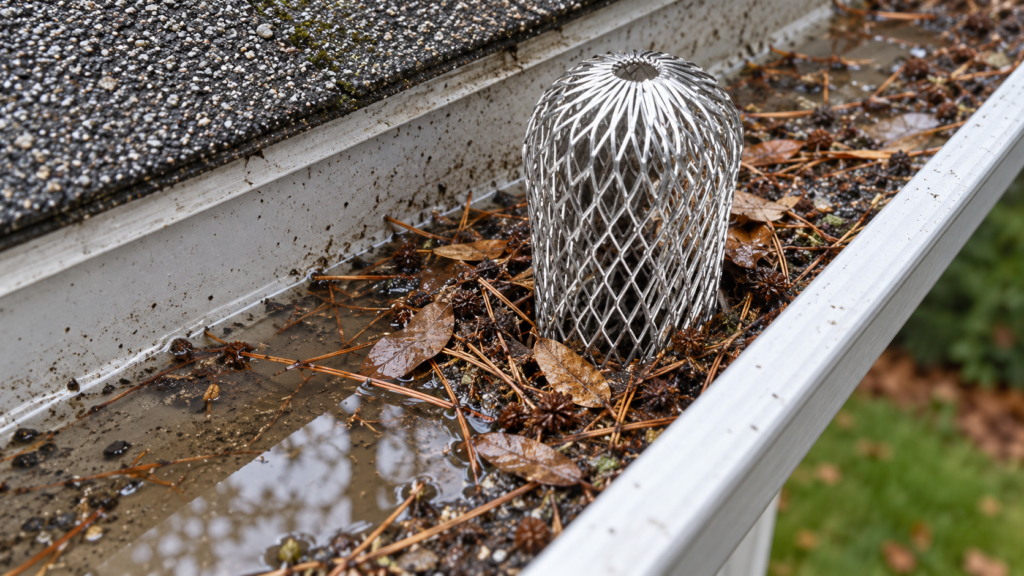
A wire basket or dome-shaped screen placed over the downspout opening looks like a smart, inexpensive way to keep leaves out of the downspout. It can stop large debris from entering the pipe—but that does not always mean it improves the gutter system.
Based on what we see while inspecting and cleaning gutters in Sinking Spring and throughout Berks County, we generally do not recommend this type of downspout strainer as a permanent, maintenance-free solution. In areas with leaves, pine needles, seed pods and roof granules, the basket often becomes a choke point at the most important drain location in the entire gutter.
What the strainer is designed to do
The device sits directly over the outlet where water leaves the gutter and enters the downspout. Its purpose is simple: catch leaves and other material before they travel into the downspout or an underground drain.
That can be useful in a limited situation—for example, when an underground drain or rainwater system must be protected and the screen is easy to inspect and clean frequently. The problem begins when the basket is treated as a set-it-and-forget-it gutter guard.
Why the gutter may clog faster
An open downspout outlet allows water and some small, movable debris to leave the gutter. A basket strainer changes that outlet into a much smaller filtering surface.
During rain, small debris is carried toward the downspout. Pine needles, leaf fragments, seed pods, shingle granules and dirt become caught in the mesh or packed around its base. Each new piece of debris catches the next one. The resulting mat can block water long before the rest of the gutter looks full.
The downspout itself may still be open, but water cannot reach it efficiently.
What happens after the outlet is blocked
Once the outlet area is restricted, rainwater begins backing up along the gutter. In a heavy storm, that can cause:
- water to spill over the front edge of the gutter;
- water to run behind the gutter or toward the fascia;
- staining on siding and exterior surfaces;
- saturated soil near the foundation;
- unnecessary stress on gutter joints and hangers;
- ice buildup around the outlet during freeze-and-thaw weather.
This is why a clean-looking downspout below the gutter does not guarantee that the system is draining correctly. The blockage may be sitting above it, wrapped around the basket.
Does a downspout strainer ever make sense?
Sometimes—but only with the right expectations.
A strainer may help protect a buried drain, rain barrel or difficult-to-access downstream pipe from larger debris. If it is used, it should remain accessible and be checked regularly, especially after storms and during leaf season. It is not a substitute for gutter cleaning, proper outlet sizing or a correctly designed gutter-protection system.
For homes surrounded by trees or exposed to pine needles and fine roof debris, we usually prefer to keep the outlet as open as practical and address debris across the gutter system instead of concentrating it at one small drain point.
A better approach
The right solution depends on the roof, tree coverage, gutter size, downspout size and where the water discharges. A practical approach may include:
- cleaning the gutter and flushing every downspout;
- confirming that the outlet is properly sized and not restricted;
- correcting gutter pitch so water moves toward the outlet;
- adding or enlarging downspouts where the roof area requires more capacity;
- selecting a gutter-guard system that sheds debris instead of trapping it at the outlet;
- scheduling seasonal inspection when the property has heavy tree coverage.
The goal is not simply to stop debris from entering the downspout. The goal is to keep rainwater moving safely away from the roof, fascia and foundation.
Our recommendation
We do not recommend installing a wire downspout basket without considering how much debris reaches the gutter and who will maintain the screen. For many Berks County homes, the basket only moves the clog from inside the downspout to the top of the outlet—where it can cause overflow sooner.
If your gutter spills over near a downspout, do not assume the pipe needs replacement. The outlet, strainer, gutter pitch or available drainage capacity may be the real problem.
Gutters Marketplace LLC provides gutter cleaning, downspout repair, gutter repair and seamless gutter installation in Sinking Spring and surrounding Berks County communities. Call (484) 339-4177 or request an estimate online for an inspection of the complete drainage path.