
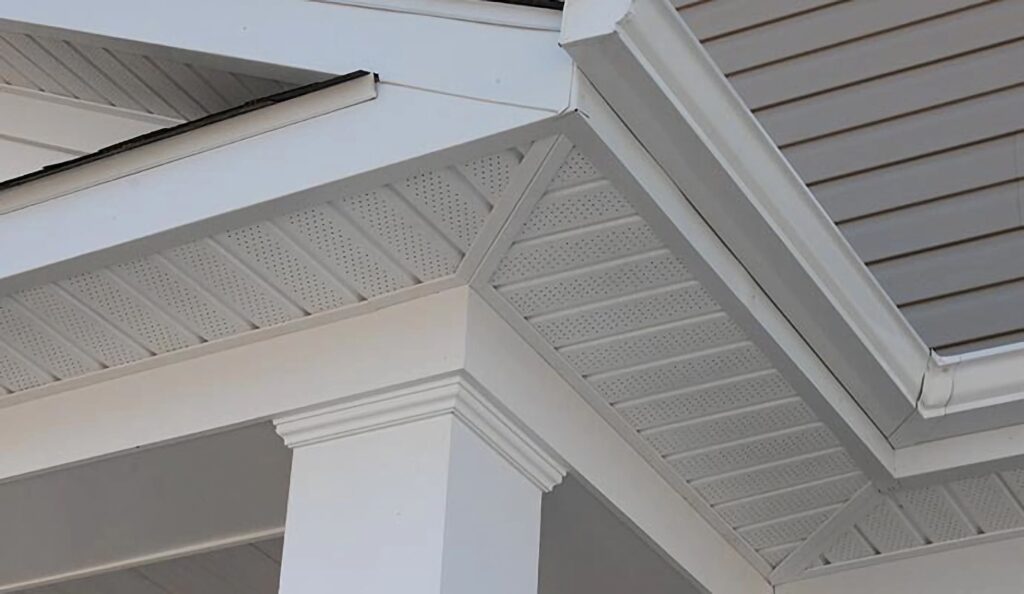
Soffit and fascia sit at the roof edge, but they do different jobs. Fascia provides the visible vertical surface behind the gutter, while soffit closes the underside of the eave and may help ventilate the roof assembly. When either component deteriorates, the first visible clue may appear around the gutter rather than inside the attic.
Central Florida heat, humidity, wind-driven rain, clogged gutters, roof leaks, and repeated overflow can all expose weak areas. Early inspection matters because new gutters need a stable mounting surface and because cosmetic damage may be connected to a larger moisture problem.
Seven soffit and fascia warning signs
1. Peeling paint or dark staining along the roof edge
Peeling paint, discoloration, streaking, or persistent dirt lines can indicate that water is repeatedly reaching the fascia. The source may be gutter overflow, a leaking corner, water moving behind the gutter, a roof-edge detail, or another condition above the fascia.
A stain alone does not identify the cause. Watch where water travels during rain and inspect the gutter, drip edge, roof edge, and fascia together.
2. Soft, swollen, or crumbling fascia
Wood fascia that feels soft, flakes, swells, or no longer holds fasteners securely should be evaluated before attaching a new gutter. Covering a weak board with a fresh system can hide the problem without restoring the mounting surface.
The damaged area may be limited, or it may extend farther behind the gutter than the visible section suggests. Removing a failing gutter can reveal conditions that were not accessible during the first exterior inspection.
3. Sagging or pulling gutters
A gutter that pulls away from the roof edge may have loose fasteners, damaged hangers, overloaded debris, standing water, or weakened fascia. Sagging is not automatically a fascia failure, but the attachment surface should be checked before simply adding more fasteners.
If water remains in the gutter after rain, the system may also have a pitch or outlet problem. See our guide to gutter repair versus replacement for the factors that affect that decision.
4. Gaps, loose panels, or visible movement
Soffit panels and fascia covers should remain secure at the eave. Gaps can develop after wind exposure, impact, previous repairs, or deterioration of the material behind them. Loose pieces may move in the wind and can allow insects or small animals to investigate the opening.
Do not assume every open seam is only cosmetic. The connection between the soffit, fascia, roof edge, and gutter should be reviewed as one assembly.
5. Water marks below the soffit
Water marks on walls, porch ceilings, soffit panels, or the underside of the eave can come from several directions. A clogged gutter may overflow backward. A corner may leak. Water may travel behind the gutter, or a roof leak may emerge at the eave.
Because water can move before it becomes visible, the stain may not sit directly below the source. Inspection during or soon after rainfall can provide useful evidence.
6. Pest activity near the eaves
Insects, birds, and small animals may use loose soffit, damaged fascia, or open transitions as entry points. Pest activity does not prove the material is rotten, but repeated activity in one location is a reason to inspect the opening and the surrounding roof-edge components.
Repair the building opening as well as the visible symptom. If moisture created the weak area, the water source should be corrected so the repair is not exposed to the same condition.
7. Musty odor, attic moisture, or ventilation concerns
Some soffit systems include ventilation openings that support attic airflow. Painted-over vents, blocked perforations, missing panels, or poorly planned replacement materials can affect that path. Interior condensation or a musty attic can have several causes, so ventilation should be assessed as part of the broader roof and attic system.
Soffit replacement should preserve required ventilation rather than simply close the visible opening.
How gutters can contribute to fascia damage
A gutter is mounted at the edge of the roof, often directly to the fascia. When water cannot move through the system, it may spill over the front, run behind the gutter, or remain in a low section. Repeated wetting can damage finishes and contribute to deterioration of vulnerable material.
Common gutter-related causes include:
- debris blocking the gutter channel or outlet;
- clogged downspouts;
- leaking corners and end caps;
- incorrect pitch or standing water;
- too few outlets for concentrated roof runoff;
- loose hangers or separated sections;
- missing or ineffective roof-edge water control;
- downspouts that discharge where water returns toward the structure.
Professional gutter cleaning and a water-flow check can help determine whether the gutter system is contributing to the problem.
Should fascia be repaired before new gutters?
A new gutter should be attached to a suitable, stable surface. If the fascia is visibly damaged or cannot hold fasteners, repair should normally be addressed before or as part of the gutter installation scope. The estimate should separate gutter work from fascia or soffit work so the homeowner knows what is included.
When the fascia is sound, a new 6-inch seamless system can be measured and planned around the roofline, valleys, outlets, and safe discharge points. Learn more on the Central Florida gutter installation page.
What an exterior inspection should review
A useful inspection follows the water path instead of looking at one isolated board. It should consider:
- roof edges and visible transitions;
- drip-edge relationship to the gutter;
- gutter attachment and pitch;
- corners, seams, outlets, and end caps;
- fascia condition around fasteners;
- soffit panels, vents, and open gaps;
- downspout routing and ground discharge;
- interior or attic evidence reported by the homeowner.
Roofing, structural framing, mold remediation, and pest removal may require a different specialist. A clear contractor should explain where the gutter or exterior scope ends.
Do not wait for the gutter to fall
Minor staining or one loose panel does not always mean a major repair, but delay can make the source harder to separate from the damage it causes. If the roof edge changes after storms, if the gutter begins pulling away, or if water repeatedly appears behind the system, schedule an inspection before installing new guards or gutters over the area.
Request a soffit and fascia assessment in Central Florida
Gutters Market provides soffit, fascia, gutter repair, cleaning, and seamless gutter services across Orlando, Oviedo, and surrounding Central Florida communities. We can review the visible roof edge and define which parts of the work belong in the written scope.
Visit our Central Florida soffit and fascia page, use the estimate form, or call 407-987-4080.