
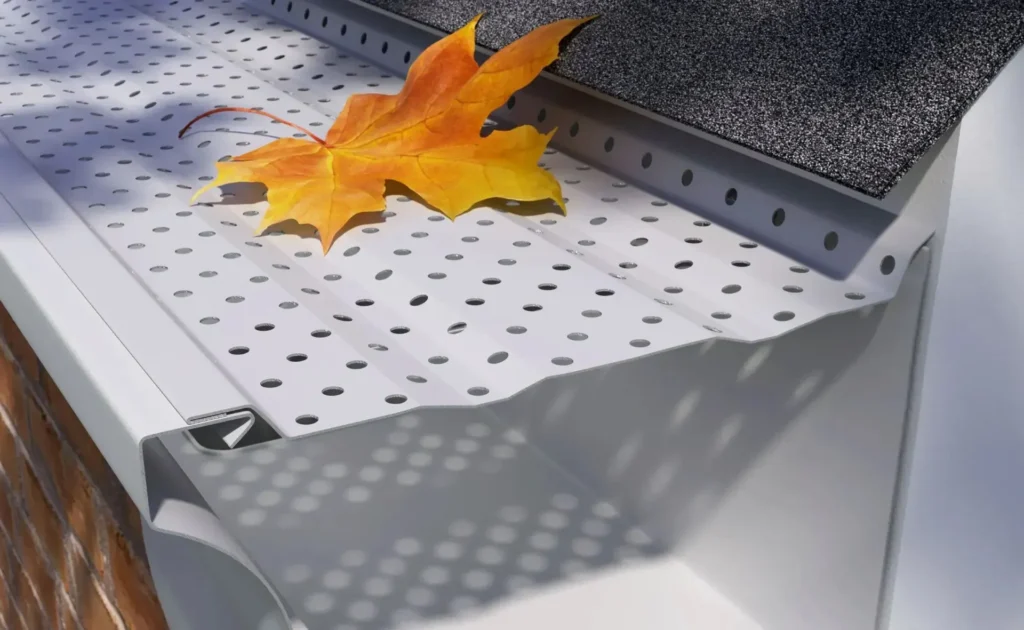
Choosing a gutter guard in Central Florida is not simply a choice between “covered” and “uncovered.” The opening size, material, roof pitch, tree debris, gutter capacity, and ability to service the system later all matter. Two common options are a perforated aluminum guard—our Classic system—and a finer Mesh system.
Both are designed to reduce the amount of leaves and debris entering the gutter. Neither makes a gutter system maintenance-free. The better choice depends on what falls on the roof, how quickly water reaches the eave, and how the existing gutters and downspouts are configured.
Classic vs. Mesh gutter guards: the short answer
Classic perforated aluminum guards are a practical choice for larger leaves and common roof debris. Their rigid aluminum surface has visible perforations that admit rainwater while helping leaves stay above the gutter channel.
Mesh gutter guards use smaller openings and can provide an additional level of screening for finer debris. They may be useful around pine needles, seed pods, small roof particles, and other material that can pass through larger openings.
The most effective option is the one matched to the property after the roof edge, debris type, gutter condition, valleys, and downspout locations have been reviewed.
Side-by-side comparison
- Opening size: Classic uses larger perforations; Mesh uses finer openings.
- Typical debris: Classic is well suited to larger leaves; Mesh adds screening for smaller material.
- Water entry: Both need correct installation and enough open surface for the roof’s runoff pattern.
- Surface cleaning: Leaves, pollen, and roof sediment can collect on either style and should be inspected.
- Service access: The guard should be installed so future cleaning and repair remain practical.
- Best decision: Choose after evaluating the roof, nearby trees, existing gutters, and discharge path—not by product name alone.
How Classic perforated aluminum guards work
A perforated aluminum guard creates a rigid surface over the gutter. Rain passes through the openings while many leaves and larger pieces of debris remain above the channel. Dry material may blow away or can be removed during periodic service.
Classic can be a good fit when the main concern is broad leaves, twigs, and larger organic debris. Aluminum does not introduce a plastic screen across the roof edge, and the rigid panel can be formed to sit cleanly with a standard K-style gutter system.
Performance still depends on installation. A guard that is poorly fitted at corners, roof valleys, end caps, or transitions can leave gaps. Those areas deserve the same attention as the long straight runs.
How Mesh gutter guards are different
Mesh guards use a finer screen to limit smaller debris from entering the gutter. That can be helpful when the property has pine needles, small seeds, blossoms, granular roof sediment, or mixed tree cover. The finer surface creates a different balance between screening and water entry.
Mesh is not automatically the best answer for every home. Heavy runoff from a steep roof or concentrated roof valley must still be evaluated. The screen surface also needs to remain clear enough for water to pass through. A product should be selected for the actual conditions rather than because it sounds more advanced.
Central Florida conditions that affect the choice
Roof valleys and concentrated runoff
A large portion of a roof can drain toward one valley. During a strong Florida storm, that water reaches a small section of gutter quickly. Guard type, pitch, gutter size, outlet placement, and downspout capacity all work together at that location.
Oak leaves, pine needles, and seed debris
Large oak leaves behave differently from pine needles, seed pods, blossoms, and roof grit. Walk the property and look at what actually collects on the roof, patio, and driveway. That material is a better guide than a generic product comparison.
6-inch gutters and 3×4 downspouts
Gutters Market works with 6-inch K-style seamless gutters and 3×4 downspouts. A guard should support—not restrict—the drainage plan. If the gutter is undersized, poorly pitched, or served by too few outlets, adding a cover does not correct the underlying problem. For more capacity context, see our guide to 5-inch vs. 6-inch gutters in Central Florida.
Do gutter guards eliminate cleaning?
No responsible gutter guard plan should be described as maintenance-free. Guards reduce the debris entering the channel, but material can still settle on top, collect near valleys, work into edges, or accumulate around outlets. Roof sediment can also move through small openings over time.
The inspection interval depends on the trees, roof, guard type, storm exposure, and previous blockage history. A home under heavy tree cover may need more frequent checks than a property with an open roofline. Our guide on how often to clean gutters in Central Florida explains the main timing factors.
What gutter guards cannot fix
A guard can reduce debris, but it cannot correct every drainage issue. Before installation, check for:
- loose, sagging, or damaged gutter sections;
- incorrect pitch or standing water;
- leaking corners, seams, or end caps;
- blocked or poorly placed downspouts;
- rotted or unstable fascia;
- water discharging into a low area beside the home;
- roof runoff overshooting the gutter at a valley.
These conditions may require gutter repair, fascia work, cleaning, or a drainage adjustment before a guard system is added.
Questions to ask before choosing a guard
- What type of debris is most common at the property?
- Where does the roof concentrate the heaviest runoff?
- Are the gutters clean, correctly pitched, and securely attached?
- How many downspouts serve the protected runs?
- Can the system still be inspected and serviced later?
- What maintenance should be expected after installation?
- Are corners, valleys, and transitions included in the written scope?
Request a Central Florida gutter guard assessment
The best comparison is made at the roofline. Gutters Market can review the existing gutters, nearby trees, debris type, valleys, outlets, and downspouts before recommending Classic perforated aluminum or Mesh guards.
Visit our Central Florida leaf guard installation page, request an assessment through the estimate form, or call 407-987-4080.